Welcome to SuperC
Sign in to access your dashboard
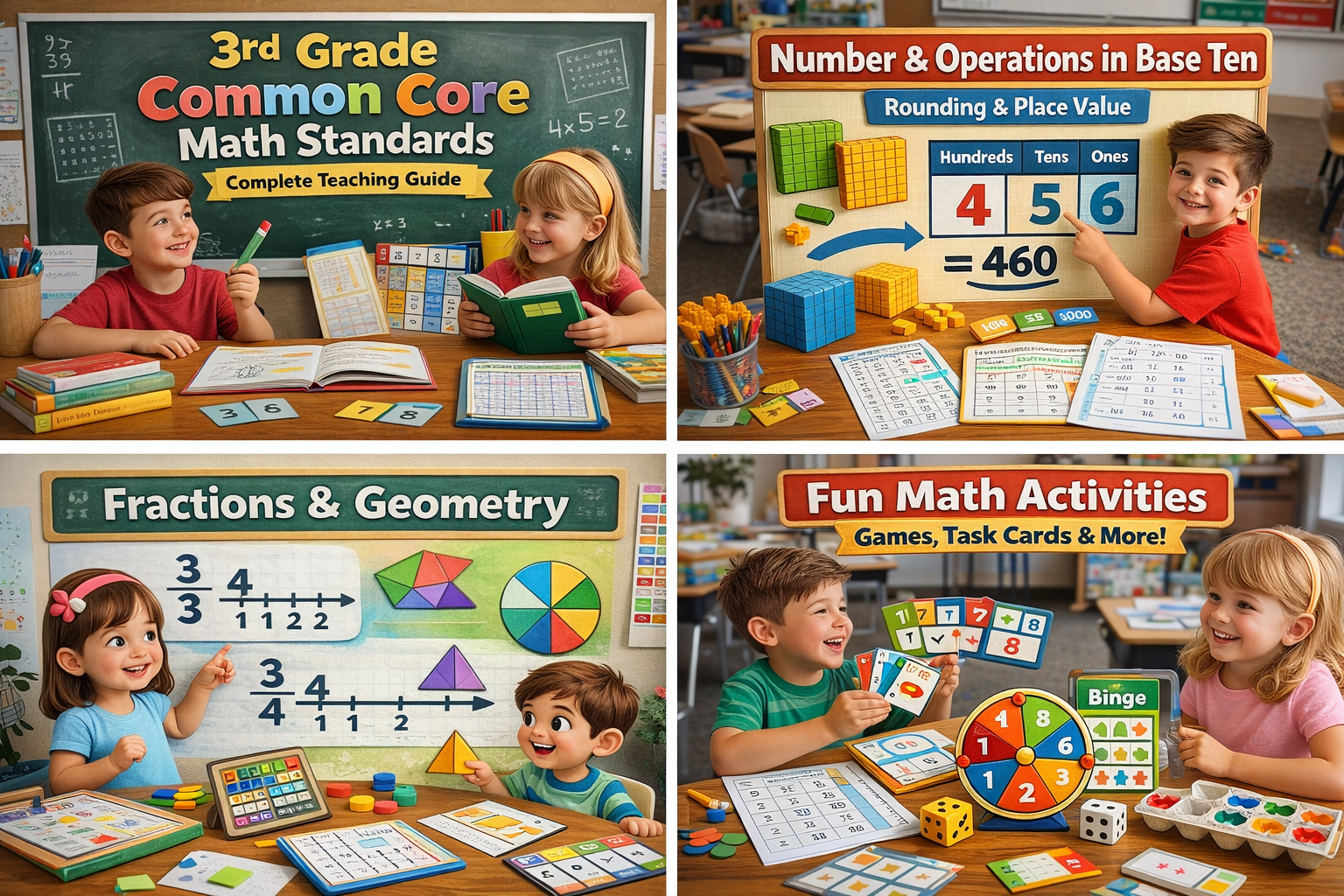
Common Core Third-Grade Math Standards: A Complete Guide
Introduction to 3rd Grade Math Standards
The 3rd Grade Common Core Math Standards serve as a roadmap for building strong mathematical foundations in young learners. These standards are designed to help students move beyond basic arithmetic and begin thinking critically about numbers, operations, and real-world problem-solving.
At this stage, children develop skills like multiplication, division, fractions, and geometry. The structure is carefully organized into Domains, Clusters, and Standards to ensure learning progresses smoothly.
Understanding this structure helps teachers plan lessons effectively and ensures students build confidence step by step.
Understanding Domains in Grade 3 Math
Domains are broad categories that group related math skills. Each domain focuses on a key area of learning, making it easier for both teachers and students to navigate the curriculum.
Key Domains in Grade 3
Number & Operations in Base Ten (NBT)
Operations & Algebraic Thinking (OA)
Measurement & Data (MD)
Number & Operations – Fractions (NF)
Geometry (G)
Each domain contains clusters, which break down into specific standards students must master.
Number & Operations in Base Ten (NBT)
This domain focuses on place value and arithmetic skills involving larger numbers. Students learn how numbers work and how to manipulate them efficiently.
📌 Cluster 3.NBT.A Explained
This cluster emphasizes using place value and operations to perform calculations.
➡️ Standard 3.NBT.1 – Rounding Numbers
Students learn to round numbers to the nearest 10 or 100. This builds estimation skills, which are essential in real-life math situations.
➡️ Standard 3.NBT.2 – Addition & Subtraction
Here, students develop fluency in adding and subtracting within 1,000. They use strategies like:
Breaking numbers apart
Using number lines
Applying place value concepts
➡️ Standard 3.NBT.3 – Multiplying by Multiples of 10
Students multiply one-digit numbers by multiples of 10 (e.g., 4 × 30). This helps them understand patterns in numbers.
👉 Practice Worksheets:
Download Math Practice Book
Grade 3 Math Practice Activities
Operations & Algebraic Thinking (OA)
This domain introduces multiplication, division, and algebraic reasoning.
📌 Cluster 3.OA.A – Multiplication & Division
Students begin understanding equal groups and sharing.
Multiplication = combining equal groups
Division = splitting into equal parts
📌 Cluster 3.OA.B – Properties of Operations
Students learn properties like:
Commutative (order doesn’t matter)
Associative (grouping doesn’t matter)
Distributive (breaking apart numbers)
These help simplify calculations.
📌 Cluster 3.OA.C – Fluency within 100
Students practice multiplication and division facts until they become automatic.
📌 Cluster 3.OA.D – Word Problems & Patterns
Students solve real-world problems and identify patterns in numbers.
👉 Practice Worksheets:
Download Math Practice Book
Grade 3 Math Practice Activities
Measurement & Data (MD)
This domain connects math to real-world measurements and data analysis.
📌 Cluster 3.MD.A – Measurement Concepts
Students learn:
Time to the nearest minute
Liquid volume
Mass using grams and kilograms
📌 Cluster 3.MD.B – Data Representation
Students create:
Bar graphs
Picture graphs
Line plots
These skills help interpret information visually.
📌 Cluster 3.MD.C – Area Concepts
Students learn that area is measured in square units and can be found using multiplication.
📌 Cluster 3.MD.D – Perimeter
Students calculate the distance around shapes and solve real-world problems.
👉 Practice Worksheets:
Download Math Practice Book
Grade 3 Math Practice Activities
Number & Operations – Fractions (NF)
Fractions are introduced as numbers, not just parts of a whole.
📌 Cluster 3.NF.A – Fractions as Numbers
Students learn to:
Represent fractions on number lines
Compare fractions
Understand equivalent fractions
Geometry (G)
Geometry focuses on shapes and their properties.
📌 Cluster 3.G.A – Shape Attributes
Students:
Identify quadrilaterals
Compare shapes
Divide shapes into equal parts
👉 Practice Worksheets:
Download Math Practice Book
Grade 3 Math Practice Activities
Teaching Strategies for Success
Teaching the 3rd Grade Common Core Math Standards effectively requires creativity and structure.
Best Practices:
Use hands-on activities (manipulatives)
Incorporate games and group work
Connect math to real-life situations
Encourage explanation and reasoning
Best Resources for Teaching Math
Here are some effective tools:
Task Cards
Interactive Slides
Math Games
Worksheets
Digital Activities
Small Group Lessons
These resources make learning engaging and interactive.
Common Challenges & Solutions
ChallengeSolution
Difficulty with multiplication
Use visual models
Struggles with fractions
Use number lines
Word problem confusion
Break into steps
Weak number sense
Practice daily
Assessment & Progress Tracking
To measure student success:
Use quizzes and tests
Monitor class participation
Assign projects
Conduct one-on-one assessments
Tracking progress helps adjust teaching strategies.
Best Resources for Learning
Teachers and parents can use:
Task cards
Digital lessons
Worksheets
Math games
Small group activities
👉 Practice Worksheets:
Download Math Practice Book
Grade 3 Math Practice Activities
FAQs About 3rd Grade Common Core Math Standards
What are the main domains in 3rd grade math?
There are five: NBT, OA, MD, NF, and Geometry.
Why are these standards important?
They ensure students build strong math foundations for future learning.
What is the hardest topic for 3rd graders?
Many students struggle with multiplication and fractions.
How can I help students learn multiplication?
Use visual aids, repeated practice, and real-life examples.
Are worksheets enough for learning math?
No, students also need interactive and hands-on activities.
How do I assess student understanding?
Use a mix of tests, observations, and projects.
Conclusion
The 3rd Grade Common Core Math Standards provide a clear and structured path for developing essential math skills. By understanding domains, clusters, and standards, teachers can deliver lessons that are both effective and engaging.
With the right strategies and resources, students can build confidence, improve problem-solving skills, and develop a lifelong love for math.
For more queries – Click Here
Comments (0)
Loading comments...