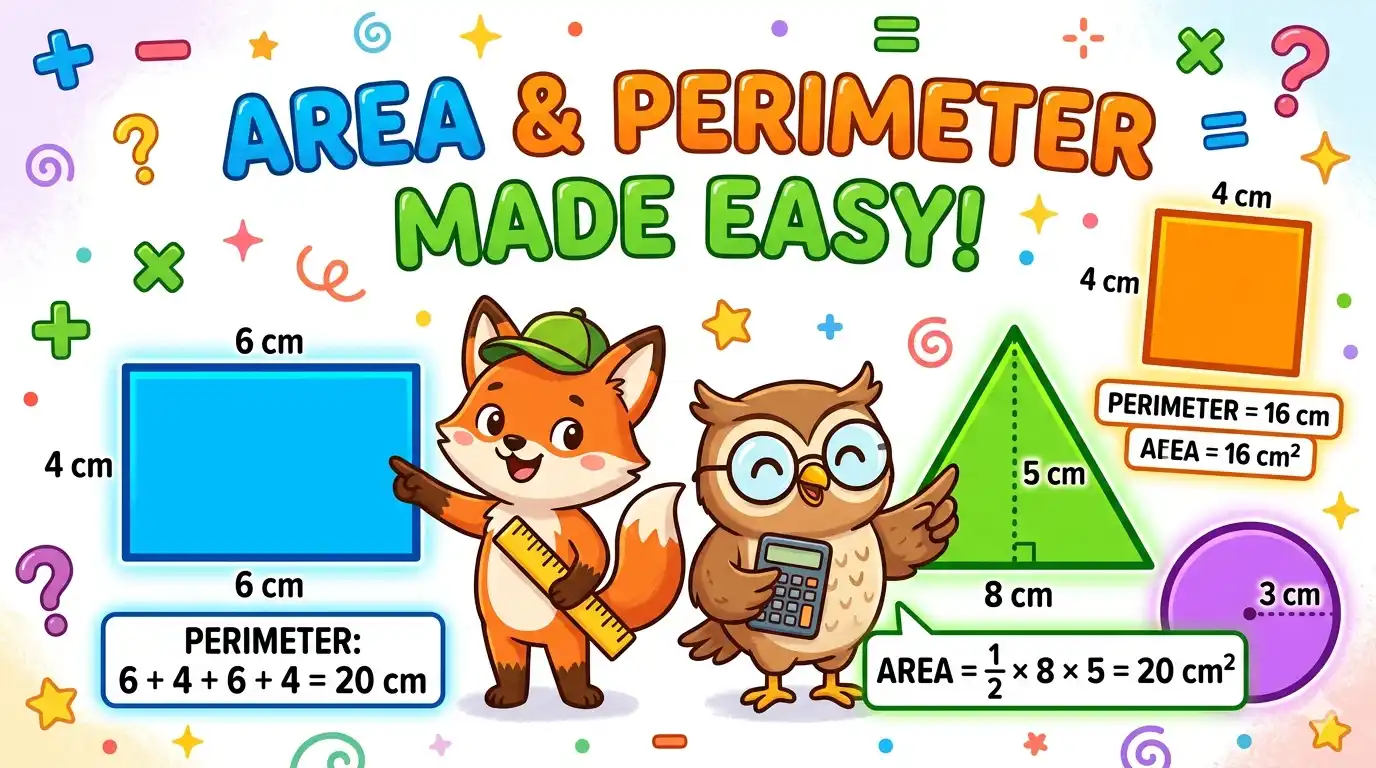
Area and Perimeter: Formulas, Examples, and Practice Problems
Understanding area and perimeter is an important part of mathematics. We use these concepts to measure the size and boundary of different shapes. Whether you are calculating the amount of paint needed for a wall, the fencing required for a garden, or the space inside a room, area and perimeter help us solve many real-life problems.
In this guide, we will learn what area and perimeter mean, how to calculate them for different shapes, which units to use, and how to solve practice problems.
What Is Perimeter?
The perimeter of a shape is the total distance around its outside boundary.
To find the perimeter, add the lengths of all the sides.
Example:-
A rectangle has a length of 8 cm and a width of 5 cm.
Perimeter:
8 + 5 + 8 + 5 = 26 cm
The perimeter is 26 cm.
For a rectangle, we can also use the formula:
Perimeter = 2 × (Length + Width)
So:
2 × (8 + 5) = 26 cm
What Is Area?
The area of a shape is the amount of space inside its boundary.
Area is measured in square units, such as square centimeters (cm²), square meters (m²), or square inches (in²).
For example, the area of a rectangle is calculated using:
Area = Length × Width
If a rectangle is 8 cm long and 5 cm wide:
Area = 8 × 5 = 40 cm²
Therefore, the area is 40 square centimeters.
Practice Area and Perimeter Online:-
Want more questions to strengthen your understanding?
 Practice area and perimeter questions online with these helpful exercises:
Class 3 Perimeter and Area Practice – Practice age-appropriate questions on perimeter and area.
Class 6 Perimeter and Area Practice – Solve a variety of Class 6 area and perimeter questions.
Mixed Questions on Perimeter and Area – Challenge yourself with mixed practice questions covering both concepts.
Regular online practice can help students improve their calculation skills, understand different types of questions, and build confidence in solving area and perimeter problems.
Calculating Area and Perimeter for Different Shapes:-
Different shapes have different formulas for calculating area and perimeter.
1. Square:-
A square has four equal sides.
Perimeter of a Square
Perimeter = 4 × Side
If each side is 6 cm:
Perimeter = 4 × 6 = 24 cm
Area of a Square
Area = Side × Side
Area = 6 × 6 = 36 cm²
So, a square with sides of 6 cm has a perimeter of 24 cm and an area of 36 cm².
2. Rectangle:-
A rectangle has two pairs of equal sides.
Perimeter of a Rectangle
Perimeter = 2 × (Length + Width)
Area of a Rectangle
Area = Length × Width
For a rectangle with a length of 10 m and a width of 4 m:
Perimeter = 2 × (10 + 4) = 28 m
Area = 10 × 4 = 40 m²
3. Triangle:-
A triangle has three sides.
Perimeter of a Triangle
Perimeter = Side 1 + Side 2 + Side 3
For a triangle with sides of 5 cm, 6 cm, and 7 cm:
Perimeter = 5 + 6 + 7 = 18 cm
Area of a Triangle
Area = ½ × Base × Height
If the base is 8 cm and the height is 5 cm:
Area = ½ × 8 × 5 = 20 cm²
Remember that the height must be measured perpendicular to the chosen base.
4. Circle:-
A circle does not have straight sides, so we use special formulas.
Circumference of a Circle
The perimeter of a circle is called its circumference.
Circumference = 2πr
where r is the radius.
Area of a Circle
Area = πr²
For calculations, π is often approximated as 3.14 or 22/7, depending on the instructions in the problem.
For example, if a circle has a radius of 5 cm:
Area = 3.14 × 5 × 5 = 78.5 cm²
Units of Measurement:-
Choosing the correct unit is important when calculating area and perimeter.
Units for Perimeter:-
Because perimeter measures distance, it uses ordinary length units:
Millimeters (mm)
Centimeters (cm)
Meters (m)
Kilometers (km)
Inches (in)
Feet (ft)
Units for Area:-
Because area measures the space inside a shape, it uses square units:
Square millimeters (mm²)
Square centimeters (cm²)
Square meters (m²)
Square kilometers (km²)
Square inches (in²)
Square feet (ft²)
A useful rule to remember is:
Perimeter → units
Area → square units
For example, a garden might have a perimeter of 30 m and an area of 50 m².
Practice Problems on Area and Perimeter:-
The best way to understand area and perimeter is through regular practice.
Try solving the following questions and check your answers afterward.
Practice Problems:-
Problem | Shape | Given Information | Find |
|---|---|---|---|
Problem 1 | Square | Side = 9 cm | 1. Perimeter |
Problem 2 | Rectangle | Length = 12 m | 1. Perimeter |
Problem 3 | Triangle | Sides = 6 cm, 8 cm, 10 cm | 1. Perimeter |
Problem 4 | Circle | Radius = 4 cm | 1. Circumference |
This format is more compact and works well for a blog, especially when followed by the Answers table.
Practice Area and Perimeter Online:-
Want more questions to strengthen your understanding?
 Practice area and perimeter questions online with these helpful exercises:
Class 3 Perimeter and Area Practice – Practice age-appropriate questions on perimeter and area.
Class 6 Perimeter and Area Practice – Solve a variety of Class 6 area and perimeter questions.
Mixed Questions on Perimeter and Area – Challenge yourself with mixed practice questions covering both concepts.
Regular online practice can help students improve their calculation skills,
understand different types of questions, and build confidence in solving area and perimeter problems.
Answers:-
Problem | Shape | Perimeter / Circumference | Area |
|---|---|---|---|
Answer 1 | Square | 4 × 9 = 36 cm | 9 × 9 = 81 cm² |
Answer 2 | Rectangle | 2 × (12 + 7) = 38 m | 12 × 7 = 84 m² |
Answer 3 | Triangle | 6 + 8 + 10 = 24 cm | ½ × 8 × 6 = 24 cm² |
Answer 4 | Circle | 2 × 3.14 × 4 = 25.12 cm | 3.14 × 4 × 4 = 50.24 cm² |
Frequently Asked Questions on Area and Perimeter?
What is the difference between area and perimeter?
Perimeter measures the distance around a shape, while area measures the space inside a shape.
Is perimeter measured in square units?
No. Perimeter is measured in regular length units such as centimeters or meters.
Area is measured in square units such as cm² or m².
What is the formula for the area of a rectangle?
The formula is:
Area = Length × Width
What is the formula for the perimeter of a rectangle?
The formula is:
Perimeter = 2 × (Length + Width)
How do you find the area of a square?
Multiply the side length by itself:
Area = Side × Side
How do you find the perimeter of a square?
Multiply the side length by 4:
Perimeter = 4 × Side
Can a shape have the same area but a different perimeter?
Yes. Different shapes can have the same area while having different perimeters.
Conclusion:-
Area and perimeter are useful mathematical concepts that help us understand the size and boundaries of shapes.
To calculate perimeter, add the lengths around the outside of a shape.
To calculate area, use the appropriate formula to find the space inside it.
Learning the basic formulas for squares, rectangles, triangles, and circles makes it much easier to solve geometry problems.
Always pay attention to the units and remember that area is expressed in square units, while perimeter uses regular units of length.
With regular practice, calculating area and perimeter can become quick, simple, and even fun!
For more queries – Click Here
Comments (0)
Loading comments...