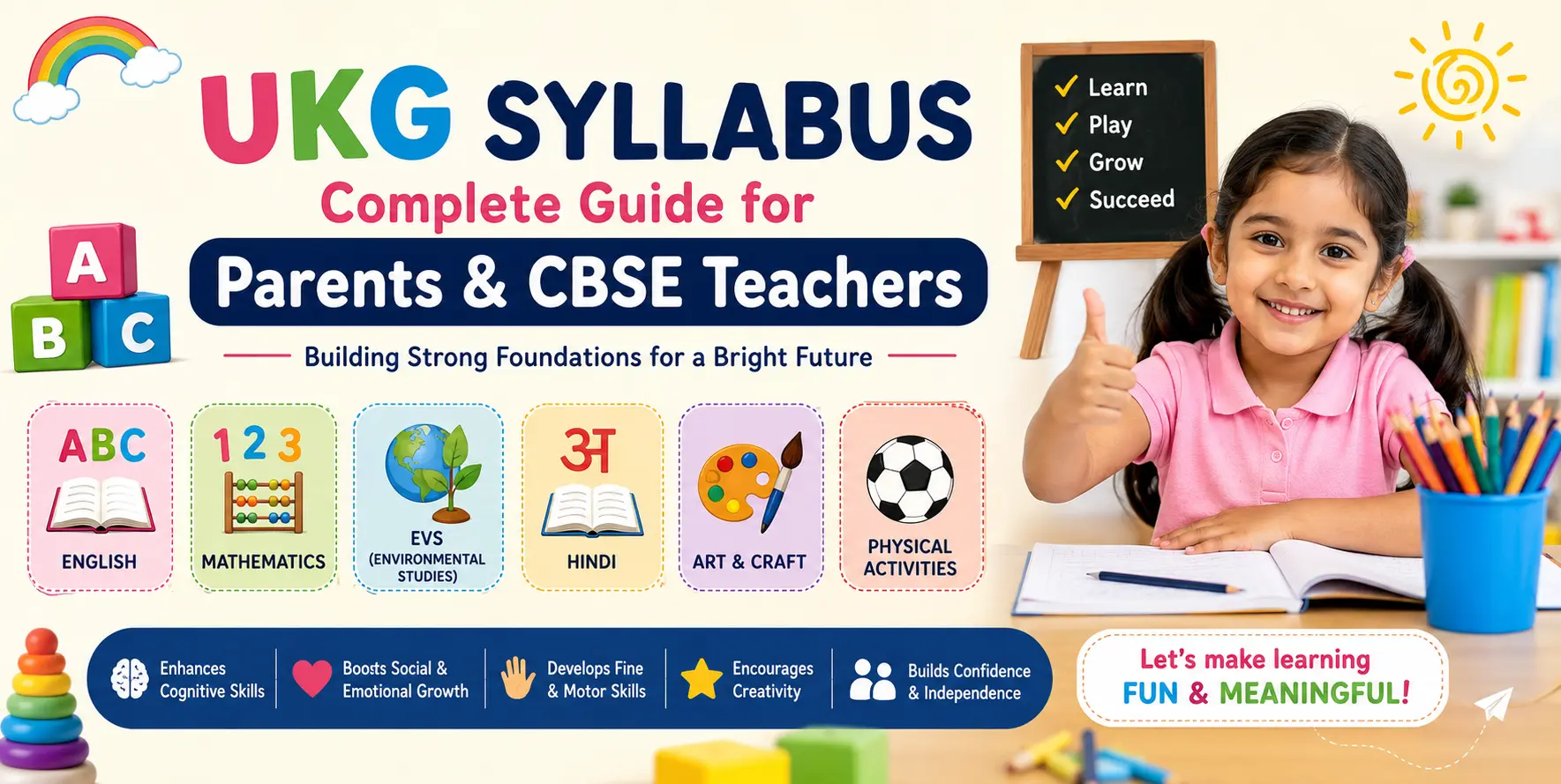
UKG Syllabus: Complete Guide for Parents & CBSE Teachers
The UKG Syllabus plays a vital role in shaping a child’s early learning journey. UKG, or Upper Kindergarten, is one of the most important stages in preschool education because it builds the foundation for formal schooling. A well-designed UKG curriculum helps children improve language skills, mathematical thinking, creativity, communication, and social development.
For parents and CBSE teachers, understanding the UKG syllabus is essential to guide children effectively. In today’s competitive academic environment, early childhood education is no longer limited to alphabets and numbers. Instead, it focuses on overall personality development through fun, activity-based learning methods.
This complete guide explains the CBSE-oriented UKG syllabus, subject-wise topics, teaching strategies, and learning resources that can help children grow with confidence and curiosity.
Introduction to the UKG Syllabus
The UKG syllabus is designed for children aged 5 to 6 years. It prepares young learners for Class 1 by introducing structured academic concepts in an engaging and playful manner.
The syllabus generally includes:
- English
- Mathematics
- Environmental Studies (EVS)
- Hindi or regional language
- Art and Craft
- Physical Education
- Rhymes and Storytelling
CBSE schools usually follow activity-based learning techniques to make concepts easier and more enjoyable for children.
Why UKG Education Matters in Early Childhood
Early childhood education has a direct impact on a child’s future academic success. During UKG, children develop:
- Communication skills
- Listening abilities
- Problem-solving skills
- Emotional intelligence
- Fine motor coordination
- Social interaction habits
At this stage, children absorb information quickly. Therefore, a balanced UKG syllabus helps build confidence and improves readiness for primary school.
Understanding the CBSE-Based UKG Curriculum
The CBSE-oriented UKG curriculum focuses on holistic learning instead of rote memorization. Teachers use visual aids, games, songs, and practical activities to teach concepts.
Learning Through Play Methodology
Children learn best when they enjoy the process. Play-based education includes:
- Flashcards
- Role-play activities
- Puzzle games
- Rhymes and music
- Hands-on experiments
These methods improve memory retention and make classroom learning more interactive.
Cognitive and Emotional Development Goals
A structured UKG curriculum also focuses on:
- Building curiosity
- Encouraging creativity
- Improving attention span
- Developing teamwork skills
- Teaching discipline and routines
UKG English Syllabus
English learning in UKG focuses on communication and literacy skills.
Alphabet Recognition and Phonics
Students learn:
- Capital and small letters
- Letter sounds
- Phonics basics
- Vowel and consonant recognition
Teachers often use songs, charts, and storytelling to improve phonetic understanding.
Vocabulary Building Activities
Children develop vocabulary through:
- Picture identification
- Naming objects
- Opposite words
- Action words
- Rhyming words
These activities help improve speaking confidence.
Reading and Sentence Formation
Basic reading skills include:
- Simple sight words
- Two-letter and three-letter words
- Small sentence reading
- Picture comprehension
UKG Mathematics Syllabus
Mathematics in UKG introduces logical thinking and number understanding.
Number Recognition and Counting
Students learn:
- Counting from 1–100
- Backward counting
- Missing numbers
- Number names
- Before, after, and between numbers
Shapes, Patterns, and Measurements
Children are introduced to:
- Basic shapes
- Pattern recognition
- Comparisons like big/small and long/short
- Time basics
- Spatial understanding
Basic Addition and Subtraction
Simple mathematical operations are taught using:
- Beads
- Toys
- Counting blocks
- Visual objects
This practical method makes calculations easier for young minds.
UKG EVS (Environmental Studies) Syllabus
EVS helps children understand the world around them.
Family, Community, and Nature
Topics usually include:
- Family members
- Community helpers
- Animals and birds
- Plants and trees
- Seasons and weather
Health and Hygiene Awareness
Children learn good habits such as:
- Washing hands
- Brushing teeth
- Eating healthy food
- Keeping surroundings clean
Hindi Language Syllabus for UKG
Hindi learning improves regional language understanding and communication.
Swar and Vyanjan Learning
Children practice:
- Hindi vowels (Swar)
- Consonants (Vyanjan)
- Simple letter writing
- Sound recognition
Picture Reading and Simple Words
Activities include:
- Matching pictures
- Word formation
- Small Hindi poems
- Oral practice sessions
Art, Craft, and Creative Development
Creative learning enhances imagination and emotional expression.
Activities include:
- Coloring
- Paper folding
- Clay modeling
- Drawing
- Finger painting
These tasks improve hand-eye coordination and creativity.
Physical Activities and Motor Skill Development
Physical education is an essential part of the UKG syllabus.
Children participate in:
- Jumping games
- Running activities
- Yoga
- Dance
- Ball games
These exercises improve balance, flexibility, and physical health.
Best Teaching Strategies for CBSE Teachers
Teachers play a major role in making the UKG syllabus effective.
Interactive Classroom Activities
Successful UKG classrooms use:
- Smart boards
- Flashcards
- Group learning
- Educational toys
- Activity corners
Storytelling and Visual Learning
Storytelling helps children:
- Improve listening skills
- Build imagination
- Learn moral values
- Increase vocabulary
Visual learning techniques make lessons easier to remember.
How Parents Can Support UKG Learning at Home
Parents can make learning more enjoyable by creating a positive environment at home.
Helpful tips include:
- Reading bedtime stories
- Practicing counting games
- Using educational charts
- Encouraging drawing and coloring
- Maintaining a daily routine
Consistency between school and home learning improves child development significantly.
Digital Learning Resources and Practice Platforms
Online practice platforms can strengthen UKG concepts through interactive worksheets and games.
Useful Practice Resources
- CBSE Official Website — Curriculum updates and academic resources.
- NCERT Learning Resources — Foundational educational materials for young learners.
- Toppr Learning Platform — Practice exercises and interactive learning activities.
- thesuperc Kids Learning — Fun educational topics and UKG worksheets.
- thesuperc Worksheets — Printable activities and learning sheets.
Practice Worksheets online
Want UKG worksheets and practice exercises for daily learning?
👉 Online UKG Practice Worksheets
👉 Explore Interactive UKG Learning Activities
👉 Get CBSE-Aligned Practice
Common Challenges in UKG Learning
Some children may face difficulties such as:
- Short attention spans
- Fear of speaking
- Writing coordination issues
- Difficulty understanding numbers
Teachers and parents should use encouragement and patience to help children overcome these challenges.
Assessment Pattern in UKG Classes
UKG assessments are usually activity-based instead of formal exams.
Evaluation methods include:
- Oral assessments
- Worksheet activities
- Observation techniques
- Class participation
- Creative projects
This reduces pressure on children and encourages natural learning.
Benefits of a Structured UKG Syllabus
A proper UKG curriculum offers several long-term benefits:
BenefitImpact
Early Literacy Skills
Improves reading and writing
Numeracy Skills
Builds mathematical confidence
Social Skills
Encourages teamwork
Creativity
Enhances imagination
Emotional Development
Builds confidence and discipline
FAQs About UKG Syllabus
1. What subjects are included in the UKG syllabus?
The UKG syllabus generally includes English, Mathematics, EVS, Hindi, Art & Craft, Physical Education, and storytelling activities.
2. Is the UKG syllabus the same in all CBSE schools?
Most CBSE schools follow similar foundational learning objectives, but activities and teaching methods may differ slightly.
3. How can parents help children learn the UKG syllabus faster?
Parents can support learning through games, storytelling, worksheets, and regular practice at home.
4. Are exams conducted in UKG classes?
Most schools use activity-based assessments instead of traditional written exams.
5. Why is play-based learning important in UKG?
Play-based learning improves memory, creativity, communication, and problem-solving skills in young children.
6. Which online resources are best for UKG practice?
Platforms like thesuperc Kids Learning and Education.com offer quality UKG learning materials and worksheets.
Conclusion
The UKG Syllabus is much more than an academic framework. It is the foundation of a child’s intellectual, emotional, and social growth. A strong UKG curriculum helps children develop confidence, curiosity, communication skills, and readiness for primary education.
For parents and CBSE teachers, understanding the syllabus structure and using engaging teaching methods can create a positive learning experience for children. Combining classroom instruction with fun home activities and digital learning tools ensures balanced development during these crucial early years.
By focusing on creativity, communication, and concept-based learning, the UKG syllabus prepares children not only for Class 1 but also for lifelong learning success.
For more queries – Click Here
Comments (0)
Loading comments...