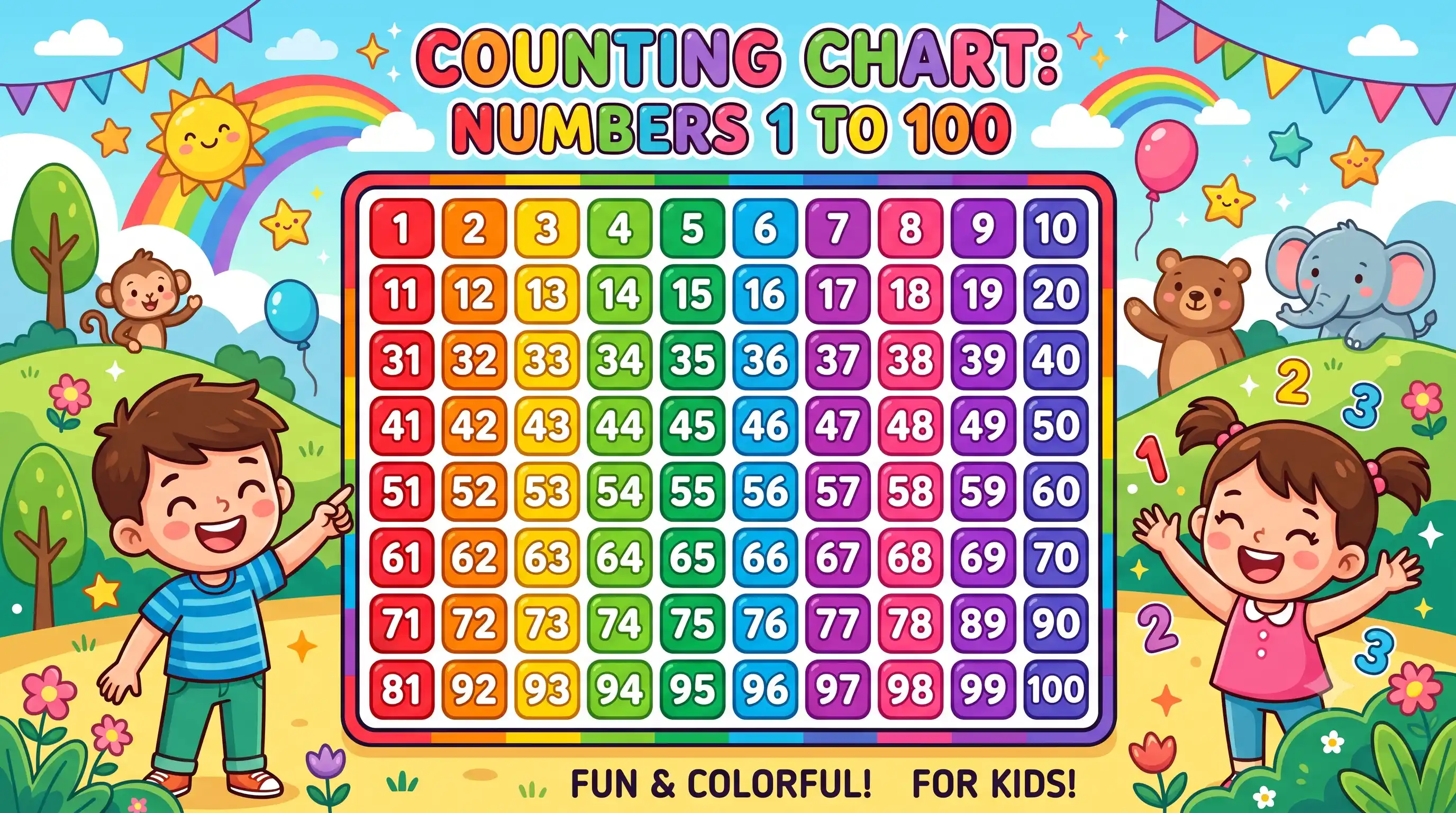
English Counting Chart: Numbers 1 to 100
Learning to count from 1 to 100 is an important first step in a child’s mathematics journey. A 1 to 100 counting chart helps children recognize numbers, learn number names, understand number order, and develop basic counting skills.
This simple counting guide is useful for LKG, UKG, Kindergarten, preschool, and early primary learners. Children can use it at home or in the classroom for everyday number practice.
What Is a Counting Chart?
A counting chart is a visual learning tool that shows numbers in their correct sequence. It helps children understand that numbers follow a particular order and makes number recognition easier.
A 1 to 100 number chart can be used to practice:
Number recognition
Counting forward
Counting backward
Number names
Before and after numbers
Missing numbers
Number sequencing
Counting in tens
Basic English Counting Chart: Numbers 1 to 100
1 – One | 2 – Two | 3 – Three | 4 – Four |
|---|---|---|---|
5 – Five | 6 – Six | 7 – Seven | 8 – Eight |
9 – Nine | 10 – Ten | 11 – Eleven | 12 – Twelve |
13 – Thirteen | 14 – Fourteen | 15 – Fifteen | 16 – Sixteen |
17 – Seventeen | 18 – Eighteen | 19 – Nineteen | 20 – Twenty |
21 – Twenty-one | 22 – Twenty-two | 23 – Twenty-three | 24 – Twenty-four |
25 – Twenty-five | 26 – Twenty-six | 27 – Twenty-seven | 28 – Twenty-eight |
29 – Twenty-nine | 30 – Thirty | 31 – Thirty-one | 32 – Thirty-two |
33 – Thirty-three | 34 – Thirty-four | 35 – Thirty-five | 36 – Thirty-six |
37 – Thirty-seven | 38 – Thirty-eight | 39 – Thirty-nine | 40 – Forty |
41 – Forty-one | 42 – Forty-two | 43 – Forty-three | 44 – Forty-four |
45 – Forty-five | 46 – Forty-six | 47 – Forty-seven | 48 – Forty-eight |
49 – Forty-nine | 50 – Fifty | 51 – Fifty-one | 52 – Fifty-two |
53 – Fifty-three | 54 – Fifty-four | 55 – Fifty-five | 56 – Fifty-six |
57 – Fifty-seven | 58 – Fifty-eight | 59 – Fifty-nine | 60 – Sixty |
61 – Sixty-one | 62 – Sixty-two | 63 – Sixty-three | 64 – Sixty-four |
65 – Sixty-five | 66 – Sixty-six | 67 – Sixty-seven | 68 – Sixty-eight |
69 – Sixty-nine | 70 – Seventy | 71 – Seventy-one | 72 – Seventy-two |
73 – Seventy-three | 74 – Seventy-four | 75 – Seventy-five | 76 – Seventy-six |
77 – Seventy-seven | 78 – Seventy-eight | 79 – Seventy-nine | 80 – Eighty |
81 – Eighty-one | 82 – Eighty-two | 83 – Eighty-three | 84 – Eighty-four |
85 – Eighty-five | 86 – Eighty-six | 87 – Eighty-seven | 88 – Eighty-eight |
89 – Eighty-nine | 90 – Ninety | 91 – Ninety-one | 92 – Ninety-two |
93 – Ninety-three | 94 – Ninety-four | 95 – Ninety-five | 96 – Ninety-six |
97 – Ninety-seven | 98 – Ninety-eight | 99 – Ninety-nine | 100 – One Hundred |
Why Is Counting 1 to 100 Important?
Counting is one of the most basic math skills children learn. Strong counting skills help children understand quantities and prepare them for more advanced mathematical concepts.
Learning to count from 1 to 100 helps children:
Recognize and identify numbers
Understand number order
Connect numbers with quantities
Learn number names
Practice simple addition and subtraction
Compare numbers
Develop early problem-solving skills
Build confidence in mathematics
Counting Forward
Counting forward means saying numbers in their normal order.
For example:
1, 2, 3, 4, 5, 6, 7, 8, 9, 10
Children can gradually continue:
11, 12, 13, 14, 15...
until they reach 100.
Encourage children to point at each number while saying it aloud. This connects the written number with the spoken number.
Counting Backward
Once children are comfortable with forward counting, they can start practicing backward counting.
For example:
10, 9, 8, 7, 6, 5, 4, 3, 2, 1
Later, children can practice from larger numbers:
20, 19, 18, 17, 16, 15...
Backward counting helps children develop number awareness and supports early subtraction skills.
Before and After Numbers
Children should learn which number comes before and after a given number.
For example:
Before 10 → 9
10 → 11 comes after
Some practice questions are:
What comes before 15?
Answer: 14
What comes after 25?
Answer: 26
What comes before 50?
Answer: 49
What comes after 79?
Answer: 80
Finding Missing Numbers
Missing-number activities are a fun way to practice number sequences.
Example 1
1, 2, 3, __, 5
Answer: 4
Example 2
15, 16, __, 18, 19
Answer: 17
Example 3
27, __, 29, 30
Answer: 28
Example 4
46, 47, 48, __, 50
Answer: 49
Counting in Tens
Children can use the 1 to 100 chart to learn how to count in tens:
10, 20, 30, 40, 50, 60, 70, 80, 90, 100
Counting by tens helps children recognize number patterns and prepares them for place value, addition, and multiplication.
Counting Everyday Objects
One of the easiest ways to teach counting is to use objects children see every day.
Ask children to count:
Toys
Books
Pencils
Blocks
Fruits
Buttons
Steps
Balls
For example, place five pencils on a table and ask:
“How many pencils can you count?”
Encourage the child to touch each pencil once while counting.
Fun Counting Activities
Number Hunt
Write different numbers on cards and place them around the room. Ask children to find a specific number.
For example:
“Can you find number 25?”
Missing Number Game
Show a sequence with one missing number and ask children to complete it.
21, 22, __, 24
Answer: 23
Number Flashcards
Show a number card and ask children to say the number aloud.
You can also show a number name and ask the child to identify its numeral.
Counting Objects
Give children a collection of small objects and ask them to count how many there are.
Number Coloring
Give children a 1 to 100 chart and ask them to color specific numbers.
For example:
“Color all the numbers ending in 5.”
Easy Online Counting Practice for Kids
Here are some simple activities children can try:
Start Online Practic:- Complete the Sequence
Start Online Practic:- Skip Counting Next Number
Start Online Practic:- Counting patterns upto 100?
Start Online Practic:- Identify numbers as even or odd?
Start Online Practic:- Write numbers or name up to 100 in words?
Start Online Practic:- Compare two numbers - up to 100?
Common Number Names to Remember
Some number names can be confusing for young learners, so regular practice is helpful.
20 – Twenty
30 – Thirty
40 – Forty
50 – Fifty
60 – Sixty
70 – Seventy
80 – Eighty
90 – Ninety
100 – One Hundred
Remember that the correct spelling is Forty, not “Fourty.”
Tips for Parents and Teachers
Keep counting practice simple, enjoyable, and consistent. Young children do not need to memorize all 100 numbers in one sitting.
Start with smaller groups such as 1 to 10, then move to 1 to 20, 1 to 50, and finally 1 to 100.
Use a combination of:
Number charts
Songs and rhymes
Flashcards
Worksheets
Counting games
Everyday objects
Verbal counting practice
Encourage children to read the numbers aloud and write them regularly.
Frequently Asked Questions
What is a 1 to 100 counting chart?
A 1 to 100 counting chart is a visual chart that displays the numbers from 1 through 100 in sequence. It helps children practice number recognition, counting, and number order.
Why should children learn numbers 1 to 100?
Learning numbers 1 to 100 builds an important foundation for early mathematics. It helps children recognize numbers, count objects, understand sequences, and prepare for addition and subtraction.
How can I teach counting to a young child?
Start with small numbers and gradually increase the range. Use objects, number charts, flashcards, games, and everyday counting activities to make learning engaging.
When should children learn to count to 100?
Children develop counting skills at different rates. Regular practice with small groups of numbers can gradually help them become comfortable counting to 100.
How can a counting chart help with math?
A counting chart provides a visual representation of number order. It can help children identify missing numbers, compare numbers, count forward and backward, and recognize patterns.
Conclusion
The english Counting Chart: Numbers 1 to 100 is a useful learning resource for young children developing their early math skills. By practicing number recognition, number names, counting forward and backward, missing numbers, and counting in tens, children can build a strong foundation in mathematics.
Make counting part of everyday learning by using toys, books, classroom materials, and simple games. With regular and enjoyable practice, children can become more confident with numbers 1 to 100.
Practice More with SuperC
Help your child strengthen early math skills with engaging counting worksheets, number recognition activities,
missing-number exercises, ordering numbers, and other math practice activities designed for young learners.
For more queries – Click Here
Comments (0)
Loading comments...