
Welcome to SuperC
Sign in to access your dashboard
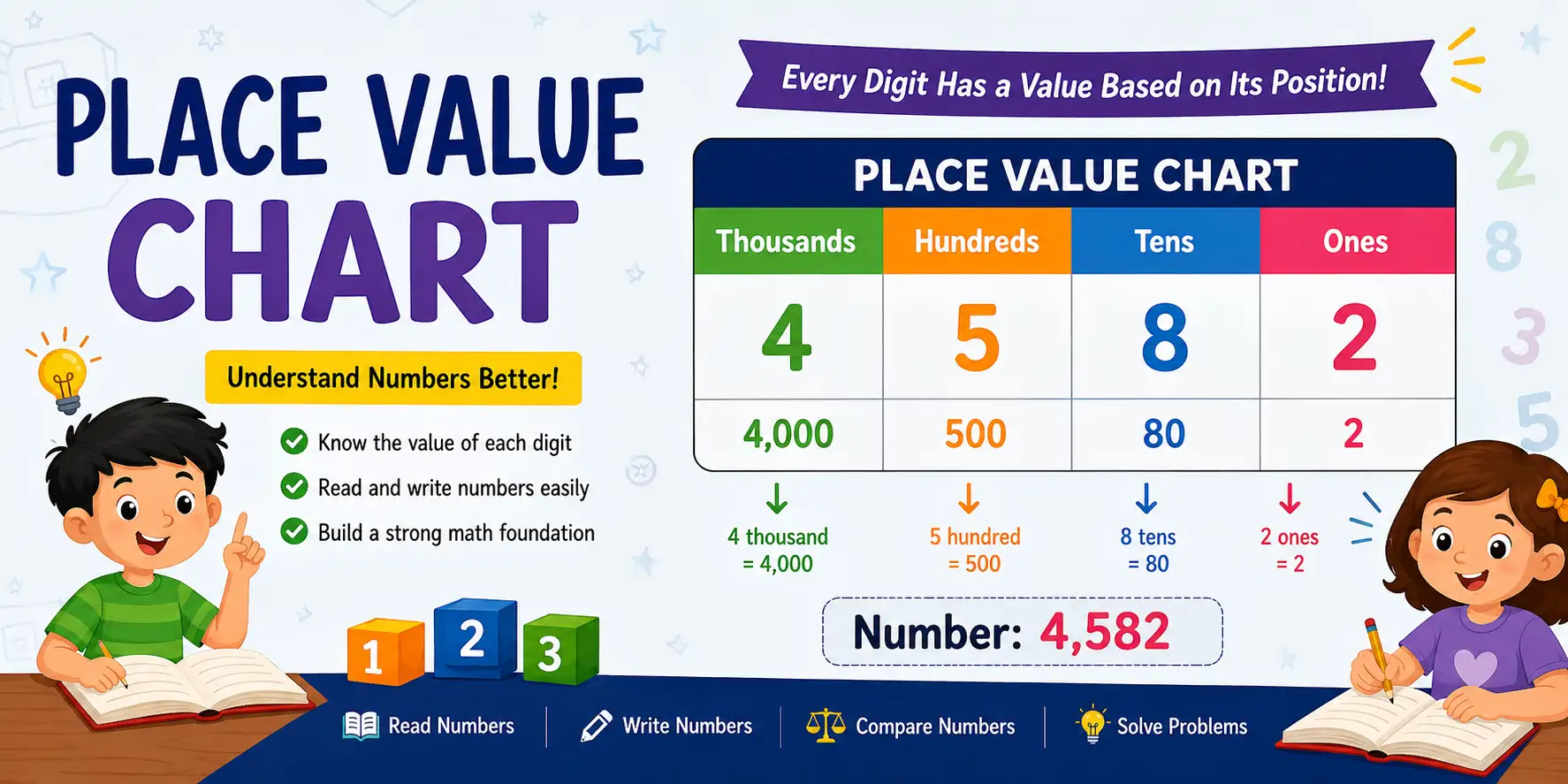
Place Value Chart: The Ultimate Guide to Understanding Numbers Easily
Mathematics is built on numbers, and one of the most important concepts for understanding numbers is the place value chart. Whether you're a student learning basic arithmetic or a parent helping with homework, understanding place value makes working with numbers much easier.
A place value chart helps us determine the value of each digit based on its position within a number. Without place value, numbers would have little meaning beyond individual digits.
What Is a Place Value Chart?
A place value chart is a visual tool used to show the value of digits according to their positions in a number.
For example, in the number 4,582:
4 is in the thousands place
5 is in the hundreds place
8 is in the tens place
2 is in the ones place
Each digit has a different value because of where it is located.
Why Place Value Matters in Mathematics
Place value is the foundation of many mathematical operations, including:
Addition
Subtraction
Multiplication
Division
Decimals
Rounding numbers
When students understand place value, they can solve problems more accurately and confidently.
Understanding Digits and Their Positions
Every digit in a number has two values:
Face Value – The actual digit itself.
Place Value – The value based on its position.
Example:
In 345:
Digit | Face Value | Place Value |
|---|---|---|
3 | 3 | 300 |
4 | 4 | 40 |
5 | 5 | 5 |
Basic Structure of a Place Value Chart
A standard place value chart looks like this:
Thousands | Hundreds | Tens | Ones |
|---|---|---|---|
4 | 5 | 8 | 2 |
This chart helps students quickly identify the value of each digit.
Ones Place
The ones place represents single units.
Examples:
1
5
9
In the number 582, the digit 2 is in the ones place.
Tens Place
The tens place represents groups of ten.
Examples:
20
50
90
In the number 582, the digit 8 represents 80.
Hundreds Place
The hundreds place represents groups of one hundred.
Examples:
100
300
700
In the number 582, the digit 5 represents 500.
Thousands Place
The thousands place represents groups of one thousand.
Examples:
1,000
4,000
9,000
In the number 4,582, the digit 4 represents 4,000.
Standard Place Value Chart
Here is a complete place value chart for whole numbers:
Ten Thousands | Thousands | Hundreds | Tens | Ones |
|---|---|---|---|---|
2 | 5 | 4 | 7 | 3 |
The number represented is:
25,473
Expanded Form and Place Value
A place value chart makes it easy to write numbers in expanded form.
Example:
Number: 6,845
Place | Value |
|---|---|
Thousands | 6,000 |
Hundreds | 800 |
Tens | 40 |
Ones | 5 |
Expanded Form:
6,000 + 800 + 40 + 5
Reading Numbers Using a Place Value Chart
Consider the number:
34,672
Ten Thousands | Thousands | Hundreds | Tens | Ones |
|---|---|---|---|---|
3 | 4 | 6 | 7 | 2 |
Read it as:
Thirty-four thousand, six hundred seventy-two.
A place value chart helps break large numbers into manageable parts.
Writing Numbers Using a Place Value Chart
Suppose you have:
5 in the thousands place
2 in the hundreds place
8 in the tens place
1 in the ones place
The number becomes:
5,281
This method helps students build numbers correctly.
Place Value Chart for Large Numbers
As numbers become larger, more place value columns are added.
Millions
Millions | Hundred Thousands | Ten Thousands | Thousands | Hundreds | Tens | Ones |
|---|---|---|---|---|---|---|
3 | 5 | 2 | 7 | 4 | 8 | 1 |
Number:
3,527,481
Billions
Billions | Millions | Thousands | Ones |
|---|---|---|---|
2 | 450 | 678 | 123 |
Number:
2,450,678,123
Large place value charts make reading huge numbers much easier.
Decimal Place Value Chart
Place value continues beyond the decimal point.
Hundreds | Tens | Ones | Decimal | Tenths | Hundredths | Thousandths |
|---|---|---|---|---|---|---|
4 | 2 | 5 | . | 7 | 3 | 9 |
Number:
425.739
Decimal Values
7 = seven tenths (0.7)
3 = three hundredths (0.03)
9 = nine thousandths (0.009)
Common Mistakes Students Make
Students often:
1. Confuse Place and Face Value
Example:
In 352, the digit 3 is not 3; its place value is 300.
2. Skip Zero Placeholders
Example:
In 5,006, zeros hold important places.
3. Misread Large Numbers
Breaking numbers into periods (thousands, millions, billions) helps avoid confusion.
Fun Activities to Learn Place Value
Number Building Game
Give students digit cards and ask them to create the largest number possible.
Place Value Blocks
Use base-ten blocks to represent:
Ones
Tens
Hundreds
Thousands
Place Value Puzzles
Challenge students to place digits into the correct columns.
Online Learning Tools
Interactive math games help reinforce place value concepts in an engaging way.
Real-Life Uses of Place Value
Place value is used every day:
Money
₹2,345 means:
2 thousands
3 hundreds
4 tens
5 ones
Population Counts
Cities often have populations in the millions.
Measurements
Decimals help measure:
Distance
Weight
Temperature
Banking
Understanding place value is essential for reading balances and transactions.
Tips for Parents and Teachers
Use Visual Aids
Charts, blocks, and diagrams improve understanding.
Practice Daily
Short daily exercises are more effective than occasional long sessions.
👉 Download Worksheets
👉 Play Live Battle Quiz
👉 Practice Daily Chapter Tests
Connect to Real Life
Use prices, phone numbers, and measurements as examples.
Encourage Expanded Form
Expanded form strengthens place value knowledge.
Frequently Asked Questions
1. What is a place value chart used for?
A place value chart helps identify the value of digits based on their position within a number.
2. Why is place value important?
It helps students understand numbers and perform arithmetic operations correctly.
3. What is the difference between face value and place value?
Face value is the digit itself, while place value depends on the digit's position.
4. How do decimals use place value?
Digits to the right of the decimal point represent tenths, hundredths, and thousandths.
5. How can children learn place value quickly?
Using charts, blocks, games, and real-life examples can improve understanding.
6. What comes after the thousands place?
The ten-thousands place comes after the thousands place.
Conclusion
The place value chart is one of the most powerful tools for understanding numbers. It teaches students how the position of a digit determines its value, making it easier to read, write, compare, and calculate numbers. From basic counting to large numbers and decimals, place value is a foundational math skill that supports future learning. By practicing regularly and using visual aids, students can master place value and build strong mathematical confidence.
For more queries – Click Here
Comments (0)
Loading comments...