
Welcome to SuperC
Sign in to access your dashboard
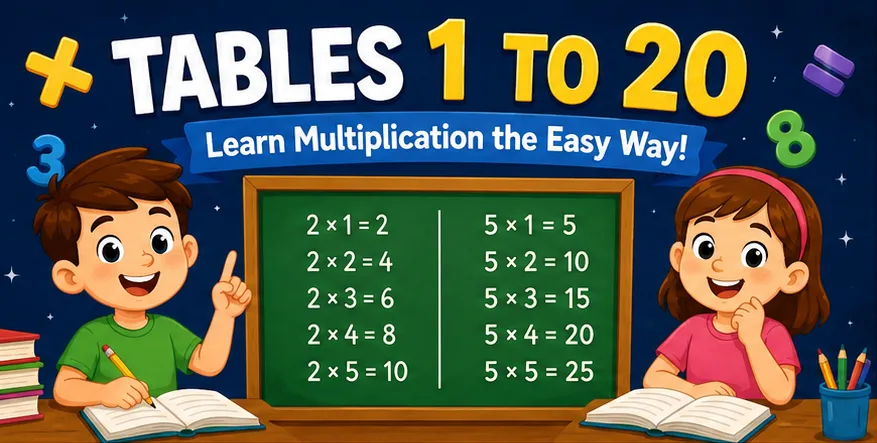
Tables 1 to 20: The Ultimate Guide for Kids to Learn Multiplication Tables Easily
Introduction to Tables 1 to 20
Tables 1 to 20 are among the most important building blocks of mathematics. Every child begins their multiplication journey by learning these tables. Once students become familiar with multiplication tables, they can solve math problems much faster and with greater confidence.
Learning tables from 1 to 20 helps children perform multiplication, division, fractions, and many other mathematical operations quickly. Educational experts consider multiplication tables a foundation for higher-level mathematics.
What Are Multiplication Tables?
Multiplication tables are organized lists that show the results of multiplying a number by other numbers.
For example:
Multiplication | Result |
|---|---|
2 × 1 | 2 |
2 × 2 | 4 |
2 × 3 | 6 |
2 × 4 | 8 |
2 × 5 | 10 |
These patterns continue for every number. Tables help students calculate answers instantly without repeatedly adding numbers.
Why Learning Tables 1 to 20 Is Important
Students who know tables 1 to 20 can:
Solve multiplication questions quickly
Improve mental math skills
Reduce calculation mistakes
Learn division more easily
Build confidence in mathematics
Prepare for advanced topics like algebra and fractions
Multiplication tables are considered the foundation of arithmetic and problem-solving skills taught throughout elementary education.
Benefits of Memorizing Tables Early
Learning multiplication tables at an early age offers many advantages.
Faster Calculations
Children spend less time calculating and more time understanding concepts.
Better Exam Performance
Quick recall improves speed during tests.
Improved Problem-Solving
Many word problems require multiplication.
Stronger Mathematical Foundation
Concepts like fractions, percentages, ratios, and algebra become easier later.
Complete Tables 1 to 20 Chart
Tables 1 to 5
Number | Multiples |
|---|---|
1 | 1, 2, 3, 4, 5, 6, 7, 8, 9, 10 |
2 | 2, 4, 6, 8, 10, 12, 14, 16, 18, 20 |
3 | 3, 6, 9, 12, 15, 18, 21, 24, 27, 30 |
4 | 4, 8, 12, 16, 20, 24, 28, 32, 36, 40 |
5 | 5, 10, 15, 20, 25, 30, 35, 40, 45, 50 |
For additional practice, students can use:
Tables 6 to 10
Number | Multiples |
|---|---|
6 | 6, 12, 18, 24, 30, 36, 42, 48, 54, 60 |
7 | 7, 14, 21, 28, 35, 42, 49, 56, 63, 70 |
8 | 8, 16, 24, 32, 40, 48, 56, 64, 72, 80 |
9 | 9, 18, 27, 36, 45, 54, 63, 72, 81, 90 |
10 | 10, 20, 30, 40, 50, 60, 70, 80, 90, 100 |
For additional practice, students can use:
Tables 11 to 15
Number | Multiples |
|---|---|
11 | 11, 22, 33, 44, 55, 66, 77, 88, 99, 110 |
12 | 12, 24, 36, 48, 60, 72, 84, 96, 108, 120 |
13 | 13, 26, 39, 52, 65, 78, 91, 104, 117, 130 |
14 | 14, 28, 42, 56, 70, 84, 98, 112, 126, 140 |
15 | 15, 30, 45, 60, 75, 90, 105, 120, 135, 150 |
For additional practice, students can use:
Tables 16 to 20
Number | Multiples |
|---|---|
16 | 16, 32, 48, 64, 80, 96, 112, 128, 144, 160 |
17 | 17, 34, 51, 68, 85, 102, 119, 136, 153, 170 |
18 | 18, 36, 54, 72, 90, 108, 126, 144, 162, 180 |
19 | 19, 38, 57, 76, 95, 114, 133, 152, 171, 190 |
20 | 20, 40, 60, 80, 100, 120, 140, 160, 180, 200 |
Easy Tricks to Learn Tables Faster
Skip Counting Method
Children can learn multiplication through repeated counting.
Examples:
Table of 2: 2, 4, 6, 8, 10...
Table of 5: 5, 10, 15, 20...
Pattern Recognition
Patterns make memorization easier.
Table of 10 always ends in zero.
Table of 5 alternates between 5 and 0.
Even-number tables produce mostly even answers.
Repetition Technique
Daily practice for 10 minutes improves memory significantly. Many educators recommend repeated reading and oral recitation for mastering tables.
Fun Activities for Practicing Tables
Children learn faster when learning feels like play.
Try:
Flashcards
Multiplication bingo
Table songs
Online quizzes
Classroom competitions
Puzzle games
Practice-based learning improves retention and confidence.
Common Mistakes Students Make
Students often:
Memorize without understanding patterns.
Skip daily revision.
Confuse similar tables such as 6 and 8.
Rush through practice exercises.
Forget higher tables after learning lower ones.
Regular review helps prevent these mistakes.
How Parents Can Help Children Learn Tables
Parents can:
Practice tables daily.
Ask quick multiplication questions.
Use charts on walls.
Reward consistent effort.
Turn learning into games.
A positive learning environment increases motivation and success.
Online Practice Resources
For additional practice, students can use:
These resources provide worksheets, exercises, and practice activities for multiplication mastery.
Real-Life Uses of Multiplication Tables
Multiplication tables are used every day.
Examples include:
Shopping calculations
Counting groups of objects
Measuring ingredients while cooking
Managing time schedules
Sports statistics
Budget planning
Children who master multiplication tables often find practical math easier.
Tips for Quick Revision
Revise 5 tables every day.
Practice before bedtime.
Write tables from memory.
Solve random multiplication questions.
Use visual charts.
Take weekly quizzes.
Consistent revision is the key to long-term retention.
Frequently Asked Questions
1. Why should children learn tables 1 to 20?
They help build strong arithmetic skills and improve calculation speed.
2. At what age should children start learning multiplication tables?
Most children begin learning basic tables around ages 6 to 8.
3. How long does it take to memorize tables 1 to 20?
With daily practice, many children can learn them within a few months.
4. Which table is easiest to learn?
The tables of 1, 2, 5, and 10 are generally considered the easiest.
5. What is the best method to learn multiplication tables?
Combining repetition, patterns, games, and practice exercises works best.
6. Are multiplication tables useful in higher classes?
Yes. They are essential for algebra, geometry, fractions, percentages, and advanced mathematics.
Conclusion
Tables 1 to 20 are one of the most valuable skills every child can learn. They strengthen mathematical understanding, improve speed, and prepare students for future learning. By using patterns, daily practice, games, and online resources, children can master multiplication tables with confidence and enjoy mathematics more.
For more queries – Click Here
Comments (0)
Loading comments...