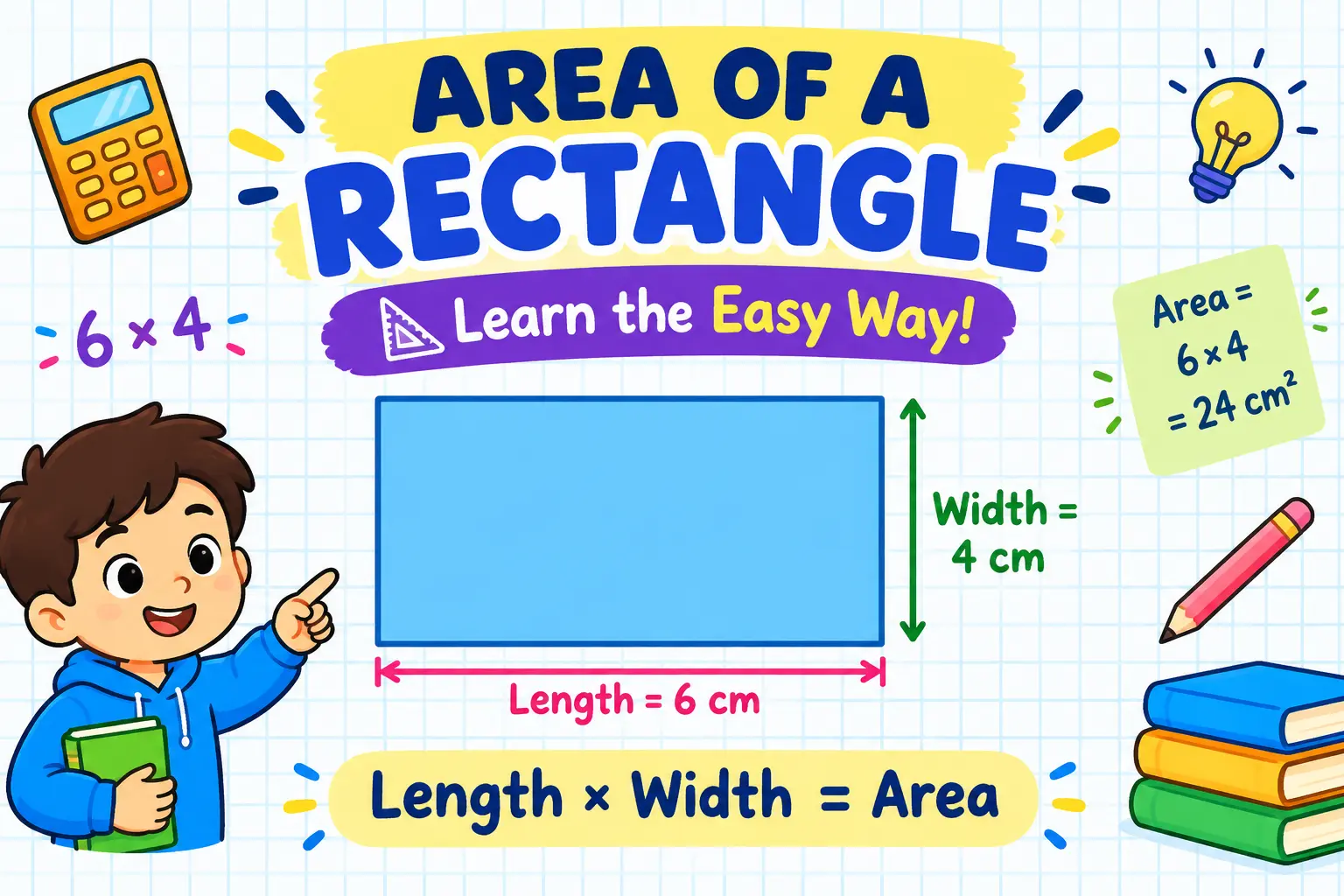
Area of a Rectangle
Understanding the area of a rectangle is an important part of elementary geometry. Whether you are finding the space covered by a classroom floor, a notebook, a garden, or a rectangular playground, the area tells you how much surface is inside the shape.
In this guide, we will learn the area of a rectangle formula, understand why it works, solve examples step by step, and practice different types of rectangle problems.
What Is the Area of a Rectangle?
The area of a rectangle is the amount of surface or space enclosed inside its four sides.
A rectangle has:
4 sides
4 right angles
Opposite sides of equal length
Opposite sides that are parallel
For example, imagine a rectangle with a length of 8 cm and a breadth of 5 cm. The space covered inside the rectangle is its area.
Area of Rectangle Formula
The standard formula is:
Area = Length × Breadth
It can also be written as:
A = l × b
Where:
A = Area
l = Length
b = Breadth or width
The answer is always written in square units, such as:
cm²
m²
km²
ft²
Example
Suppose a rectangle has:
Length = 8 cm
Breadth = 5 cm
Using the formula:
Area = Length × Breadth
Area = 8 × 5
Area = 40 cm²
Therefore, the area of the rectangle is 40 cm².
How to Find the Area of a Rectangle
Finding the area is simple when the length and breadth are known.
Step 1: Identify the length
Look at the longer side of the rectangle and note its measurement.
Step 2: Identify the breadth
Find the shorter side or width of the rectangle.
Step 3: Multiply the two measurements
Use:
Area = Length × Breadth
Step 4: Write the answer in square units
For example, if the measurements are in metres, the answer should be in square metres.
Why Is the Area of a Rectangle Length × Breadth?
Think of a rectangle divided into equal-sized squares.
Suppose a rectangle is 6 units long and 4 units wide.
There are:
6 squares in each row
and
4 rows
So the total number of square units is:
6 × 4 = 24
Therefore:
Area = 24 square units
This is why we multiply length by breadth to find the area of a rectangle.
Area of Rectangle Using Square Units
Area measures how many square units fit inside a shape.
For example, a rectangle that is 5 units long and 3 units wide can be divided into:
5 × 3 = 15
equal squares.
So its area is:
15 square units
Remember:
Length × Breadth = Number of Square Units
Solved Examples on Area of a Rectangle
Example 1: Find the Area
A rectangular notebook is 20 cm long and 15 cm wide. Find its area.
Given:
Length = 20 cm
Breadth = 15 cm
Formula:
Area = Length × Breadth
Calculation:
Area = 20 × 15
Area = 300 cm²
Answer: 300 cm²
Example 2: Find the Area of a Playground
A rectangular playground has a length of 25 m and a width of 12 m. What is its area?
Area = Length × Width
Area = 25 × 12
Area = 300 m²
Answer: The area of the playground is 300 m².
Example 3: Find the Missing Breadth
A rectangle has an area of 72 cm² and a length of 9 cm. Find its breadth.
We know:
Area = Length × Breadth
Therefore:
Breadth = Area ÷ Length
Breadth = 72 ÷ 9
Breadth = 8 cm
Answer: The breadth is 8 cm.
Example 4: Find the Missing Length
A rectangular garden has an area of 180 m² and a breadth of 12 m. Find its length.
Length = Area ÷ Breadth
Length = 180 ÷ 12
Length = 15 m
Answer: The length of the garden is 15 m.
Area of a Rectangle vs Perimeter of a Rectangle
Area and perimeter are different measurements.
Area
Area tells us how much space is inside a rectangle.
Area = Length × Breadth
The answer is given in square units.
Perimeter
Perimeter tells us the total distance around the rectangle.
Perimeter = 2 × (Length + Breadth)
The answer is given in ordinary units such as cm, m, or km.
Example
For a rectangle with length 10 cm and breadth 4 cm:
Area:
10 × 4 = 40 cm²
Perimeter:
2 × (10 + 4) = 28 cm
So:
Area = 40 cm²
Perimeter = 28 cm
Practice Area of Squares and Rectangles
Ready to apply what you've learned?
Master Class 6 Area of Squares and Rectangles with interactive practice questions on SuperC.
Start Area & Rectangles Practice →
Common Mistakes When Finding Rectangle Area
Students often make a few simple mistakes when solving area problems.
1. Forgetting the square unit
If the measurements are in centimetres, the area should be written in cm², not cm.
2. Adding instead of multiplying
Area is calculated using:
Length × Breadth
Do not add the sides when calculating area.
3. Mixing measurement units
Make sure the length and breadth use compatible units before calculating.
For example, convert metres and centimetres to the same unit first.
4. Confusing area with perimeter
Remember:
Area = space inside
Perimeter = distance around
Real-Life Uses of Rectangle Area
We use the area of rectangles in many everyday situations.
Flooring
The area of a room helps determine how much floor space needs to be covered.
Painting Walls
The surface area of a rectangular wall can help estimate the amount of paint needed.
Gardening
Gardeners can calculate the area of a rectangular garden to understand how much land is available.
Tiling
The area of a floor and the area of one tile can help determine how many tiles are needed.
Quick Formula Guide
What You Need | Formula |
|---|---|
Area | Length × Breadth |
Length | Area ÷ Breadth |
Breadth | Area ÷ Length |
Perimeter | 2 × (Length + Breadth) |
Practice Questions
Try these questions on your own.
Question 1
A rectangle has a length of 12 cm and a breadth of 7 cm. Find its area.
Question 2
A rectangular field is 30 m long and 15 m wide. Find its area.
Question 3
The area of a rectangle is 96 cm² and its length is 12 cm. Find its breadth.
Question 4
A rectangle has an area of 150 m² and a breadth of 10 m. Find its length.
Question 5
A rectangular table is 2 m long and 1 m wide. What is its area?
Answers
84 cm²
450 m²
8 cm
15 m
2 m²
Practice Area of Squares and Rectangles
Ready to apply what you've learned?
Master Class 6 Area of Squares and Rectangles with interactive practice questions on SuperC.
Start Area & Rectangles Practice →
Quick Revision
Let's remember the key points:
A rectangle has four right angles.
Area tells us the space inside a rectangle.
The formula is Area = Length × Breadth.
Area is measured in square units.
If the area and one side are known, divide to find the missing side.
Perimeter and area are different measurements.
Learn and Practice Maths with SuperC
Knowing the formula is only the beginning. The best way to become confident in maths is to solve different types of questions.
At SuperC, students can practise maths concepts with questions designed for their learning level.
Practise area, perimeter, geometry, measurement, and other maths topics, check your understanding, and build stronger problem-solving skills.
Start practising today and make maths easier, one question at a time.
For more queries – Click Here
Comments (0)
Loading comments...